
Learn · Nov 21, 2026 · The SH3 team
What "cGMP" and "FDA-Registered Facility" Really Mean (and What They Don't)
Reading time: about 4 minutes
"cGMP" means a supplement is made under the FDA's Current Good Manufacturing Practice rules, a set of legal quality standards every US supplement manufacturer must follow. "FDA-registered facility" means the facility is registered with the FDA, which is also a legal requirement. Neither one means the FDA has approved the product: the FDA does not approve dietary supplements before they're sold.
Supplements aren't approved by the FDA, and that's normal
Under the Dietary Supplement Health and Education Act (DSHEA) of 1994, the FDA does not have the authority to approve dietary supplements before they go on the market. Instead, the company selling a supplement is responsible for making sure it's safe and that its label is truthful and not misleading. The FDA can act against unsafe or mislabeled products after they're on the market.
So if you ever see "FDA approved" on a supplement, treat it as a red flag. It isn't possible for a dietary supplement.
What "cGMP" means
In 2007 the FDA issued the dietary supplement Current Good Manufacturing Practice rule, known by its regulation number, 21 CFR Part 111. It applies to anyone who manufactures, packages, labels or holds dietary supplements, and it has the full force of law.
The rule covers things like:
- Written procedures for each step of manufacturing
- Checking the identity of ingredients
- Making sure products meet specifications for identity, purity, strength and composition
- Keeping batch records so problems can be traced
- Handling complaints and recalls
The FDA inspects manufacturers for compliance and can take action when they fall short.
What "FDA-registered facility" means
Facilities that manufacture, process, pack or hold food in the US, including dietary supplements, must register with the FDA. Registration tells the FDA where facilities are and who runs them. It's a requirement, not an endorsement or a quality rating.
What these terms don't mean
- Not FDA approval. As above, supplements aren't approved.
- Not an official seal. There's no official government "cGMP certified" stamp, and misusing the FDA logo is illegal. Badges you see are the brand's own description or come from a private auditor.
- Not proof a product works. cGMP is about how a product is made, not whether it has a particular effect.
- Not a guarantee of perfection. It's a minimum legal standard every manufacturer must meet.
What actually adds confidence
- Specific, honest labels that list each ingredient and amount (see our guide to reading Supplement Facts).
- Voluntary third-party testing from independent organizations such as USP or NSF, which some brands pay for.
- A certificate of analysis (COA) showing a production batch was lab-tested.
- Clear company contact details, so you know who stands behind the product.
Where SH3 stands
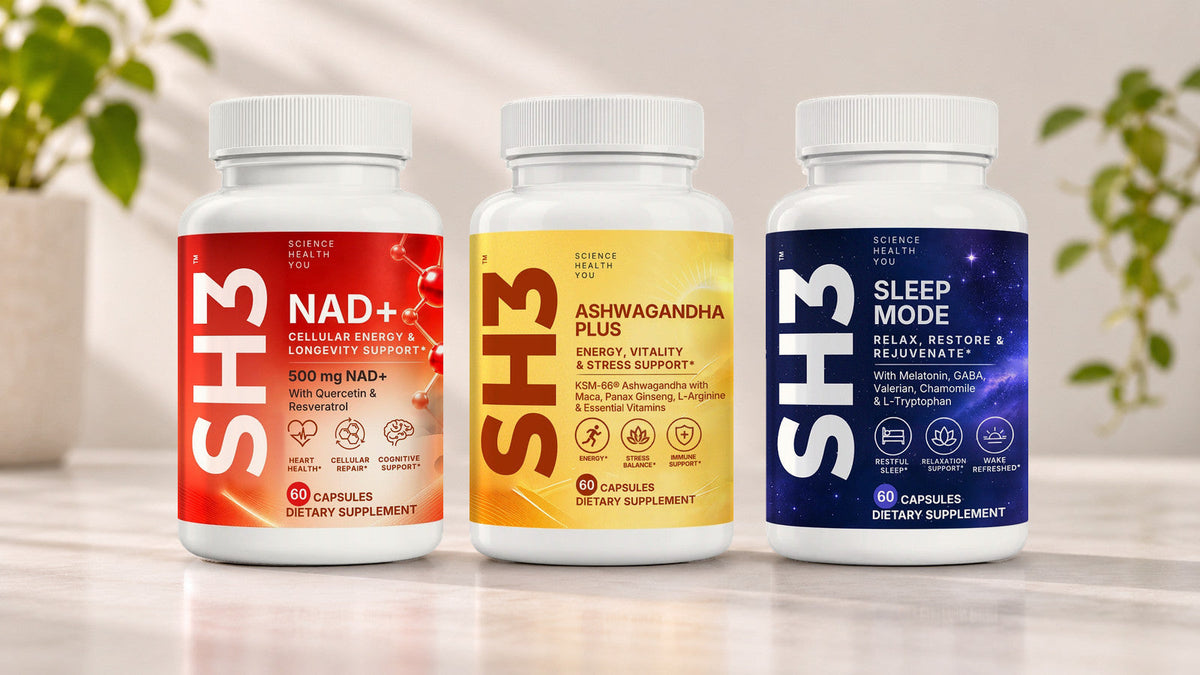
SH3 NAD+ Cellular Energy, Ashwagandha Plus and Sleep Mode are made in the USA in an FDA-registered facility that follows cGMP rules, and every production batch comes with a certificate of analysis. We see that as the baseline every supplement should meet, not a special badge. Questions? Email contact@sh3wellness.com.
Sources
- FDA. Questions and Answers on Dietary Supplements. Link
- FDA. Small Entity Compliance Guide: Current Good Manufacturing Practice in Manufacturing, Packaging, Labeling, or Holding Operations for Dietary Supplements. Link
- 21 CFR Part 111. Link
- Operation Supplement Safety (US Department of Defense). CGMP/GMP seals: What do they mean? Link
This article is for general education only and is not medical advice. These statements have not been evaluated by the Food and Drug Administration. These products are not intended to diagnose, treat, cure, or prevent any disease.